INDUSTRY:
TELECOM
COMPANY:
TIM Brasil
ROLE:
Senior Product Design Manager
YEAR:
2024-2026

AI Personas
highlights.
context.
TIM serves 55M+ customers across Brazil, with very different levels of digital literacy. Validating a journey against that diversity meant qualitative usability testing: over a month to run and synthesize, from recruiting to findings.
At that pace, testing was something we did only for big launches. Most journeys shipped validated against almost no one, and the gap between what we assumed about our customers and what we actually knew kept growing.
The question wasn't how to run better tests. It was how to make validation cheap enough to happen every week, without pretending it replaced talking to real people.
I proposed the initiative and defined how it would work: which behavioral and demographic variables defined each persona, how a test session should be scoped and what counted as a usable answer. I built it with TIM's AI team on our own infrastructure, ran the first rounds myself and then handed it over to the designers.
We got the validation cycle down to under 30 minutes. Here's how, and where the personas went wrong.


process & decisions.
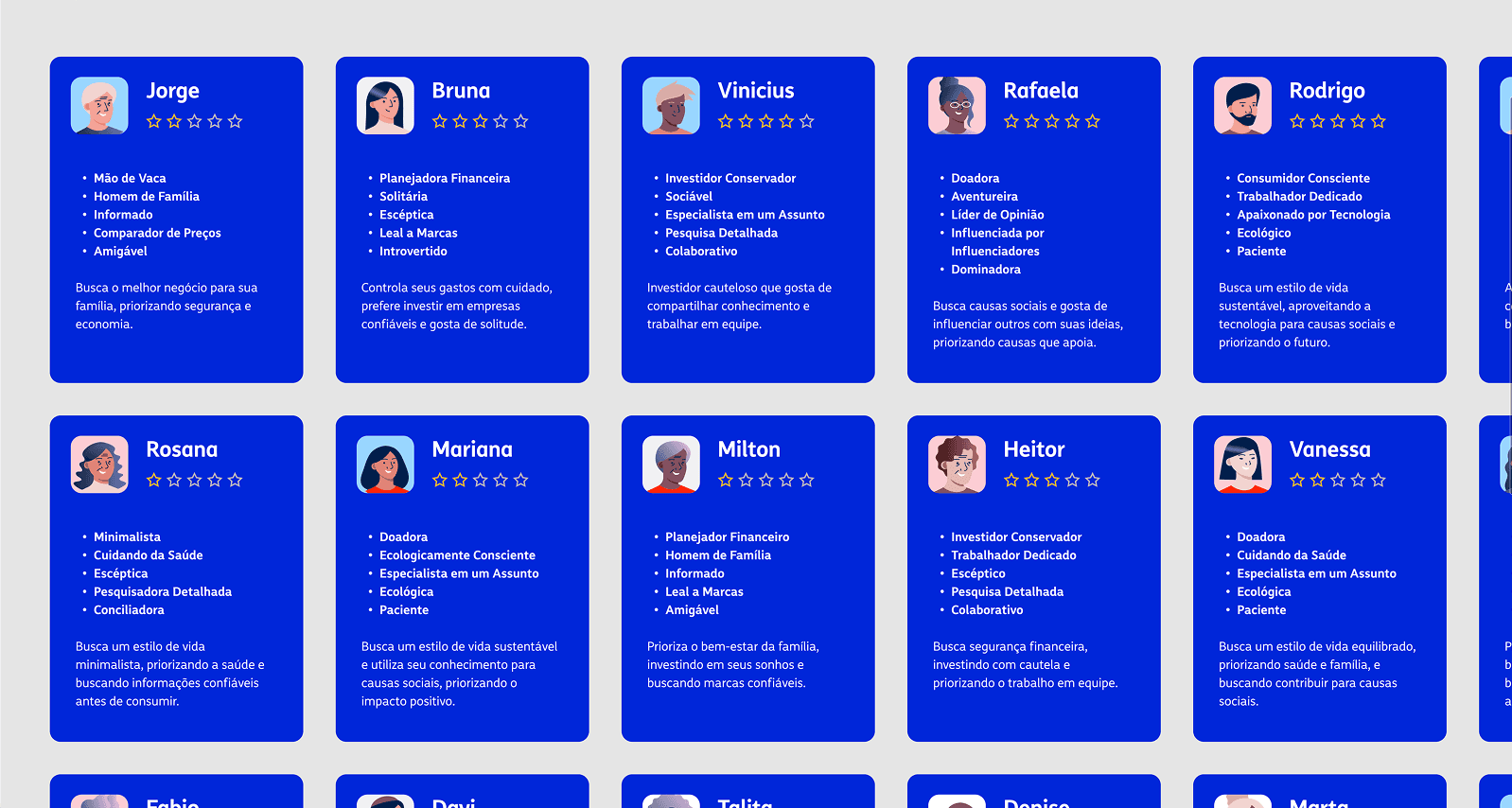
WWe built synthetic personas from real demographic, behavioral and digital-literacy data, fully anonymized and without customer registration data.
Positioned them as a pre-test layer, not a replacement for real users.
Designers used personas to close open questions: hypotheses left uncertain after their own research or a design critique with the team. Only the strongest directions went on to testing with real customers.
Autonomy for designers: any designer could run a persona test during ideation, without waiting for a research slot or approval.
Guardrails: personas were used to explore and narrow options, never as final validation. Core journeys still had usability tests with real users before delivery. Usage was open to the whole team and measured through platform tokens, not individual quotas.
Validation against real users: when we ran qualitative sessions with customers who matched the persona profiles, we heard opinions and comments very close to what the personas had predicted, sometimes almost word for word.
results.
Usability tests before journey delivery: 5x more often
Validation cycle for a design hypothesis: from ~1 month to under 30 minutes. It's not the same test: the pre-test layer catches problems before the month-long study starts, often with several hypotheses per round.
Learnings:
Synthetic personas hallucinated. They commented on interface elements that didn't exist or mixed up different journeys in the same answer. We treated it as a prompt problem, not a dead end: adjusting the prompts and running the test again fixed it. It also taught us how much output quality depends on how tightly each test is scoped, and why personas have to stay a pre-test layer. Their answers need a critical eye. Real users have the last word.